

The women and men who make hotel cleaning services possible in Singapore arrive before dawn, often travelling from the city’s periphery to central districts where gleaming towers promise luxury and comfort to guests who will never know their names. These workers carry with them not just supplies and equipment, but an intimate knowledge of what transforms an empty room into a space worthy of rest, what elevates a bathroom from merely functional to genuinely welcoming. Their labour, largely invisible to those who benefit from it, represents the foundation upon which Singapore’s hospitality industry has built its global reputation for excellence. Without professional hotel cleaning services, the promise of five-star comfort dissolves into disappointment, and the entire edifice of premium accommodation collapses.
The Physical Reality of Premium Housekeeping
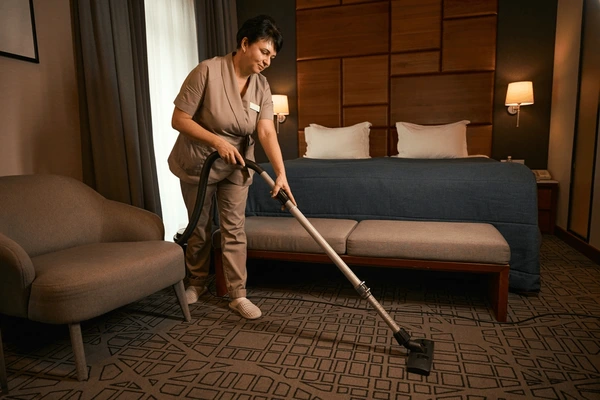
Walk into any Singapore hotel room and you encounter the result of systematic, physically demanding work. Industry standards reveal that housekeepers typically complete sixteen rooms per shift, a figure that sounds manageable until you calculate what it means in practice. Each room requires approximately thirty minutes of concentrated effort, which translates to continuous movement, bending, lifting, and detailed attention across an eight-hour day with minimal respite. The work encompasses bed-making to exacting specifications, bathroom sanitization that meets health regulations, floor care across multiple surface types, furniture dusting and polishing, amenity restocking, and quality checks that catch defects before guests notice them.
Professional hotel cleaning services understand what this labour demands. Training programmes must prepare workers for the physical intensity whilst instilling standards that guests unconsciously expect. As one industry observer notes, housekeepers complete over 200 hours of hotel-grade training to deliver results you can count on, a significant investment that reflects both the complexity of the work and the consequences of failure in hospitality environments where reputation hinges on consistency.
Standards, Compliance, and Professional Frameworks
Singapore’s hospitality sector operates within regulatory frameworks designed to protect both workers and guests. Hotel cleaning services must navigate multiple compliance requirements including health and safety standards, chemical handling protocols, and increasingly, sustainability benchmarks. The Singapore Standards Council has established guidelines that professional services follow, with SS 694:2023 compliance aligning services with guidelines for cleaning performance.
These frameworks serve important purposes beyond bureaucratic necessity. They establish minimum acceptable conditions, create accountability mechanisms, and ensure that the pressure to reduce costs doesn’t compromise either worker safety or guest wellbeing. Professional hotel cleaning services operating within these parameters provide:
- WSQ-certified staff trained in proper cleaning techniques and safety protocols
- NEA licensing ensuring regulatory compliance and industry accountability
- Bizsafe certification demonstrating commitment to workplace safety standards
- Detailed checklists guaranteeing consistent quality across all service areas
- Regular supervision and quality assurance monitoring work outcomes
- Insurance coverage protecting both workers and clients from liability
The Economics and Ethics of Outsourcing
Many Singapore hotels now outsource housekeeping operations to specialized providers, a trend driven by labour market realities and operational considerations. The arrangement offers hotels flexibility to scale operations according to occupancy whilst transferring recruitment, training, and management responsibilities to experienced contractors. For hotel cleaning services providers, the model creates employment opportunities whilst demanding efficiency and quality maintenance across multiple client properties.
This outsourcing relationship, however, carries ethical implications that deserve consideration. Workers employed by third-party hotel cleaning services may experience different conditions than direct hotel employees, potentially affecting wages, benefits, job security, and career advancement opportunities. Responsible hotels and cleaning services providers recognize these concerns and work to ensure that outsourcing arrangements don’t simply transfer costs onto workers who can least afford to bear them.
Guest Experience and Worker Dignity
The hospitality industry correctly emphasizes guest satisfaction as its primary metric, yet this focus sometimes obscures the human dimensions of service work. Every pristine bathroom, every perfectly made bed, every gleaming lobby represents someone’s labour, skill, and attention. Professional hotel cleaning services bridge this gap by treating housekeeping work as skilled labour deserving respect rather than menial tasks requiring mere effort.
The connection between worker conditions and service quality runs deeper than many realize. Hotels expecting excellence from housekeeping staff must provide the tools, training, time, and compensation that make excellence achievable. Rushed workers cutting corners to meet unrealistic quotas cannot deliver the standards that distinguish premium hospitality from budget accommodation. As Singapore’s tourism sector emphasizes its commitment to world-class experiences, that commitment must extend to those whose work creates those experiences.
Training, Professionalism, and Career Pathways
Professional hotel cleaning services invest substantially in workforce development, recognizing that skilled housekeepers represent competitive advantage. Training programmes cover technical skills including proper chemical use, equipment operation, and surface-appropriate cleaning methods. Equally important are the interpersonal dimensions: discretion, guest interaction protocols, problem-solving, and the professional bearing expected in premium hospitality environments.
For workers, these training opportunities can represent pathways to better employment conditions and career progression. Experienced housekeepers may advance to supervisory roles, training positions, or operations management within hotel cleaning services providers. The industry’s growth creates opportunities, though realizing those opportunities requires intentional investment in worker development rather than treating housekeeping as low-skill temporary employment.
Conclusion
Singapore’s reputation for hospitality excellence rests substantially on work that remains largely invisible to those who benefit from it most. Professional hotel cleaning services provide the systematic labour, trained expertise, and quality assurance that transform accommodation from merely adequate to genuinely welcoming. The industry’s continued success depends not only on operational efficiency and competitive pricing but on treating housekeeping work with the respect it deserves, ensuring that those who clean hotel rooms can themselves live with dignity, and recognizing that premium guest experiences and decent worker conditions need not exist in tension. For Singapore’s hotels seeking genuine five-star standards, choosing professional hotel cleaning services that prioritize both quality and ethics represents not additional cost but fundamental investment in the human foundation upon which all hospitality ultimately depends.

Comments are closed.