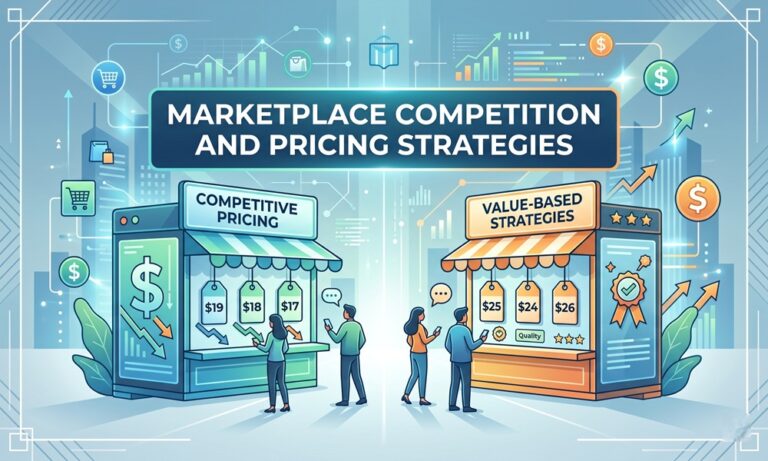
As we navigate 2026, the e-commerce marketplace landscape has reached a critical inflection point. Pricing strategy has moved decisively from a tactical function to a core driver of business performance, with sellers facing unprecedented complexity in multi-channel selling environments.
The modern marketplace demands far more than basic price-matching. Real-time competitive intelligence gains strategic importance, with retailers placing increased emphasis on tracking competitor pricing movements, promotions, and assortment changes across e-commerce platforms, marketplaces, and dealer networks.
This comprehensive guide explores the latest pricing strategies, competitive tactics, and tools that successful sellers are using in 2026 to maintain profitability while competing in ruthlessly competitive marketplaces.
Understanding the Competitive Marketplace Landscape in 2026
The Hidden Cost Reality
The critical challenge facing marketplace sellers in 2026 isn’t just competition—it’s profitability. Marketplaces like Amazon and eBay present ruthless price competition and a thicket of fees that can result in every unit sold generating a loss instead of fueling your account.
A troubling pattern emerges across the industry: Great sales dynamics and rising revenue bars mask melting profitability. The problem is that on marketplaces, the transaction price is just the tip of the iceberg.
This means successful sellers in 2026 must:
- Transition from intuitive pricing to precise financial engineering
- Account for hidden fees and costs before setting prices
- Monitor the complete “price waterfall” from list price to bank account impact
- Understand the LTV:CAC ratio (customer lifetime value to acquisition cost) and CAC payback period
Multi-Channel Pricing Strategy (2026 Reality)
Selling the same product across different marketplaces (Amazon, Bol, eBay, Google Shopping, etc.) requires careful platform-specific pricing adjustments. The challenge: Each platform has different fee structures, audience behavior, and competitive dynamics.
Multi-channel strategy involves setting different prices across various marketplaces, enabling sellers to monitor how products are priced on multiple platforms while ensuring they stay competitive and maximize profit margins.
Key 2026 Considerations:
| Channel |
Fee Structure |
Pricing Strategy |
Competitive Factor |
| Amazon |
8-15% referral + variable |
Must win Buy Box |
Highest competition |
| eBay |
5-12% variable |
Competitive positioning |
Medium-high competition |
| Direct-to-Consumer |
2-3% payment only |
Premium pricing possible |
Control brand narrative |
| Google Shopping |
Cost-per-click based |
Value-focused |
Aggregator competition |
| Specialized Marketplaces |
Platform dependent |
Niche positioning |
Lower competition |
The key insight: Rather than always competing to be the cheapest, strategic pricing aligned with brand positioning allows sellers to set prices as the 3rd or 4th lowest in the market while still maintaining competitiveness.
Core Pricing Strategies for 2026 Competitive Advantage
1. Real-Time Dynamic Pricing (The 2026 Standard)
In 2026, dynamic pricing has evolved beyond simple competitor-matching tools. Artificial intelligence tools now use real-time analytics to adjust prices based on demand, inventory, and competitor activity—a practice that can maximize revenue and profit margins quickly.
The sophisticated approach involves:
- AI-Powered Matching: Advanced systems match products across multiple platforms using image recognition and metadata analysis
- Demand Prediction: Machine learning models forecast demand based on seasonal patterns, trends, and historical data
- Inventory Optimization: Prices adjust automatically to prevent stockouts or excess inventory
- Market Response: Systems detect competitor price changes within minutes and adjust accordingly
Critical 2026 Safeguard: Frequent competitor price changes and promotional pressure have significantly shortened pricing decision cycles. Rather than periodic pricing reviews (monthly or quarterly), successful sellers now monitor markets continuously, adjusting prices based on real-time conditions while setting clear human-review thresholds for major adjustments.
2. Resale Market Integration
A significant 2026 trend involves understanding resale competition. Tools like browser extensions now scan product pages in real-time and pull comparable listings from resale platforms (eBay, The RealReal, etc.), bringing secondhand inventory into direct competition with new products at the exact moment of customer decision-making.
This requires sellers to:
- Monitor resale pricing for their products
- Adjust premium pricing strategy if resale competition is heavy
- Consider refurbished/returned items in pricing architecture
- Use resale data to refine pricing strategies based on product value retention
3. Value-Based Positioning (Beyond Lowest Price)
In 2026, market leader strategies demonstrate that strong branding and clear value communication allow for higher prices even in aggressive competition.
Rather than racing to the bottom, successful sellers now:
- Invest in brand building (“ingredient branding”)
- Clearly communicate unique selling points (USPs)
- Gauge customer perception through surveys and market research
- Assess market demand and willingness to pay
- Position products based on quality, service, and reliability
Key Metrics to Track:
- Customer Acquisition Cost (CAC) payback period
- Gross margin per product line
- Customer Lifetime Value (LTV) to CAC ratio
- Return on ad spend per channel
4. Multi-Platform Price Elasticity Testing
Advanced sellers in 2026 conduct continuous A/B testing across platforms:
- Test identical products at different price points
- Measure conversion rate impact
- Analyze how demand changes with price adjustments
- Identify price elasticity for each product category
- Use historical data to predict customer reactions
5. Psychological Pricing Optimization
Retailers continue using psychological pricing strategies (e.g., $9.99 instead of $10.00), but in 2026 this extends to platform-specific optimization:
- Understand audience perception by marketplace type
- Use charm pricing for price-sensitive segments
- Employ premium pricing display for brand-focused segments
- Test bundle pricing against individual item pricing
Advanced Competitive Analysis & Monitoring in 2026
The Shift to Continuous Market Monitoring
The defining feature of 2026 pricing strategy is abandonment of periodic price reviews in favor of continuous market monitoring and adjustment. This shift reflects:
- Pricing Volatility Becoming Constant: Price changes are no longer annual or quarterly—they’re daily or hourly
- Compressed Decision Cycles: Slow response results in rapid margin erosion, unfulfilled sales prospects, and product mispricing
- Multi-Channel Complexity: Managing prices across 5-10+ sales channels simultaneously requires automation
- Regulatory Scrutiny: Pricing decisions must be documented and defensible
Essential 2026 Competitive Pricing Tools
The top competitive pricing tools in 2026 share common features but serve different business needs:
For Amazon & eBay Sellers:
- Automated Buy Box strategy optimization
- Real-time competitor price monitoring
- Repricing rules with human approval gates
- Category-specific intelligence
For Multi-Channel Retailers:
- Cross-platform price synchronization
- Centralized inventory integration
- Promotion planning and execution
- Demand forecasting with AI
Best Practices:
- Tools should scan thousands of product pages across Amazon, Walmart, Target, Instacart, eBay, and niche marketplaces in real-time
- Integration with your central inventory system feeds raw product data and prices automatically
- Reports should provide actionable insights, not just raw data
- Scalability matters—from small catalogs to enterprise-level SKU management
Strategic Competitor Selection (Avoiding Analysis Paralysis)
Not all competitors deserve equal attention. Effective 2026 strategy involves:
- Defining exactly which competitors trigger actions (only strategic rivals, not every random seller)
- Setting maximum downward adjustments per day/week to prevent race-to-bottom dynamics
- Requiring human review for large deviations from historical pricing patterns
- Using competitor analysis dashboards to monitor automated actions and approvals
The Key Insight: Excessive focus on competitor pricing can lead to missed profit opportunities. Successful sellers balance competitive awareness with value-based positioning.
Critical Pricing Mistakes to Avoid in 2026
1. The “Naked” Price Trap
The most dangerous mistake in 2026 is focusing only on gross margin while ignoring the complete price waterfall. Many sellers fall into the trap of analyzing only the sale price without accounting for:
- Marketplace referral fees (5-15%)
- Fulfillment and logistics costs
- Advertising and promotional spending
- Payment processing fees
- Returns and refunds
- Packaging and shipping materials
- Customer acquisition costs
To Avoid This: Calculate true profit impact by running all costs through your pricing model before implementation.
2. Ignoring Hidden Marketplace Fees
Each platform has different fee structures that directly impact profitability. In 2026:
- Amazon fees vary by category (up to 45% in some cases)
- eBay fees include insertion fees, final value fees, and optional features
- Walmart Marketplace has different fee tiers
- International platforms (Allegro, Bol) have unique structures
3. Automating Without Guardrails
While AI-powered dynamic pricing is powerful, automation without proper safeguards causes problems:
- Uncontrolled price decreases erode margins rapidly
- Competitive “pricing spirals” lead to race-to-bottom dynamics
- Algorithm errors can price products far below cost
- Regulatory issues if pricing appears coordinated across accounts
2026 Solution: Implement human review requirements for deviations exceeding thresholds.
4. Misunderstanding Platform Economics
Different platforms demand different pricing approaches:
- Amazon rewards aggressive competitiveness through Buy Box algorithms
- eBay auction dynamics require different strategies than fixed-price listings
- DTC sites allow premium positioning unavailable on marketplaces
- International platforms have unique competitive pressures
5. Overcomplicating Pricing Structures
Complex pricing confuses customers and increases operational overhead. Simple is better:
- Keep promotional structures clear and time-limited
- Avoid excessive tiered pricing for similar products
- Don’t mix multiple discount types simultaneously
- Document pricing rationale for compliance audits
6. Neglecting Resale Market Competition
In 2026, secondary market pricing directly impacts new product positioning. Failing to account for resale prices on eBay, The RealReal, and other platforms can result in:
- Overpricing new items relative to used alternatives
- Brand dilution through discrepancies
- Lost sales to budget-conscious resale shoppers
- Misaligned value perception
2026 Marketplace Trends & Strategic Shifts
Focus on Retention Over Growth
As marketplaces move into 2026, teams face growing pressure to turn scale into sustainable results. A critical strategic shift is occurring: marketplace growth strategies increasingly center on execution, onboarding quality, process automation, and control over core workflows rather than rapid expansion.
This means successful sellers now prioritize:
- Customer Retention & Repeat Purchases over new customer acquisition
- Operational Efficiency over volume growth at any cost
- Selective Investment in technologies that provide measurable impact
- Quality Vendor Management over just adding more sellers
Retail Media Integration
Marketplaces are increasingly becoming media platforms, with revenue streams beyond transaction fees. Sellers must now consider:
- Sponsored product advertising costs
- Display advertising opportunities
- Native advertising integration
- Promotional placement fees
2026 Impact: Pricing must account for increased advertising dependencies to maintain visibility.
Regulatory Evolution & Compliance
While the intense algorithmic pricing regulation wave of 2025 stabilized somewhat, 2026 brings continued scrutiny:
- Price transparency requirements remain strict
- Coordinated pricing across accounts faces scrutiny
- Surveillance-based dynamic pricing faces legal challenges in multiple jurisdictions
- Documentation of pricing methodology is increasingly required for compliance
Seller Action: Keep detailed records of pricing decisions and rationale. Ensure pricing algorithms operate independently without coordination signals.
Brand Value & Market Positioning (The Antidote to Price Wars)
The strongest 2026 pricing trend shows that strong brand positioning and clear value communication allow sellers to command higher prices, even in aggressive competition.
Rather than competing on price alone, differentiation through:
- Superior product quality and reliability
- Exceptional customer service
- Faster shipping and delivery options
- Strong brand identity and customer loyalty
- Product innovation and unique features
This enables positioning at the 3rd or 4th lowest price in category rather than always being the cheapest.
Data-Driven Decision Making
In 2026, successful pricing strategy requires:
- Analysis of historical sales data and price point performance
- Monitoring how market changes (economic shifts, new competitors) impact sales
- Testing to identify price elasticity by product category
- Using market research tools to analyze demand, market size, and growth potential
- Understanding customer perception of value through surveys and interviews
2026 Pricing Implementation Framework
Phase 1: Complete Financial Audit (Week 1-2)
Before adjusting a single price, understand your complete cost structure:
- Calculate true profitability by product, accounting for all fees and costs
- Identify your LTV:CAC ratio for each product category
- Measure CAC payback period to understand customer acquisition efficiency
- Break down the price waterfall: List price → Marketplace fees → Fulfillment → Returns → Marketing → True profit
- Analyze historical pricing data to identify past pricing elasticity
Phase 2: Competitive Market Analysis (Week 2-3)
Map your competitive landscape precisely:
- Identify 3-5 strategic competitors whose pricing directly affects your market position
- Compare pricing structures including base prices, discounts, and promotions
- Analyze competitor value delivery: product quality, customer service, shipping speed
- Assess market demand using market research tools and trend analysis
- Document competitive gaps where you can differentiate beyond price
Phase 3: Strategy Development (Week 3-4)
Define your pricing policy clearly:
- Choose your primary strategy: Value-based, competitive, penetration, or premium positioning
- Set price boundaries: minimum acceptable margin, maximum competitive adjustment
- Define automation rules: Which competitors trigger actions? What are maximum daily changes?
- Establish approval thresholds: When does pricing require human review?
- Plan platform-specific approaches: Different prices for Amazon vs. DTC vs. other channels
Phase 4: Tool Selection & Implementation (Week 4-5)
Choose tools matching your scale and needs:
- Evaluate feature depth: repricing automation, cross-platform monitoring, analytics, integrations
- Test with pilot SKUs: Start with 10-20 products before rolling out company-wide
- Set guardrails: Configure approval workflows and alerting for anomalies
- Train team members: Ensure everyone understands pricing policy and tool operation
- Document processes: Create runbooks for pricing adjustments and escalations
Phase 5: Testing, Monitoring & Optimization (Ongoing)
Implement continuous improvement cycles:
- A/B test price points by product category and platform
- Monitor conversion rates at each price level
- Track margin impact weekly against targets
- Analyze competitor responses to your pricing changes
- Adjust seasonal pricing for predictable demand variations
- Review compliance regularly to ensure algorithmic pricing passes regulatory scrutiny
Critical 2026 Principle: Agility in pricing, market presence, and operational alignment are now the priorities for competitive success.
Conclusion: Pricing as Strategic Business Imperative in 2026
Pricing strategy has transformed from a back-office function into a core business discipline. In 2026, the sellers who thrive are those who recognize a fundamental truth: the transaction price is just the tip of the iceberg, and true profitability depends on sophisticated financial engineering, not intuitive pricing.
The 2026 Winning Formula
Success requires balancing seemingly contradictory imperatives:
- Automate aggressively while maintaining human oversight of critical decisions
- Monitor competitors relentlessly without obsessing over their prices
- Compete on value rather than racing to the bottom
- Stay flexible with continuous monitoring and adjustment while avoiding reactive chaos
- Invest in brand as the ultimate defense against price competition