
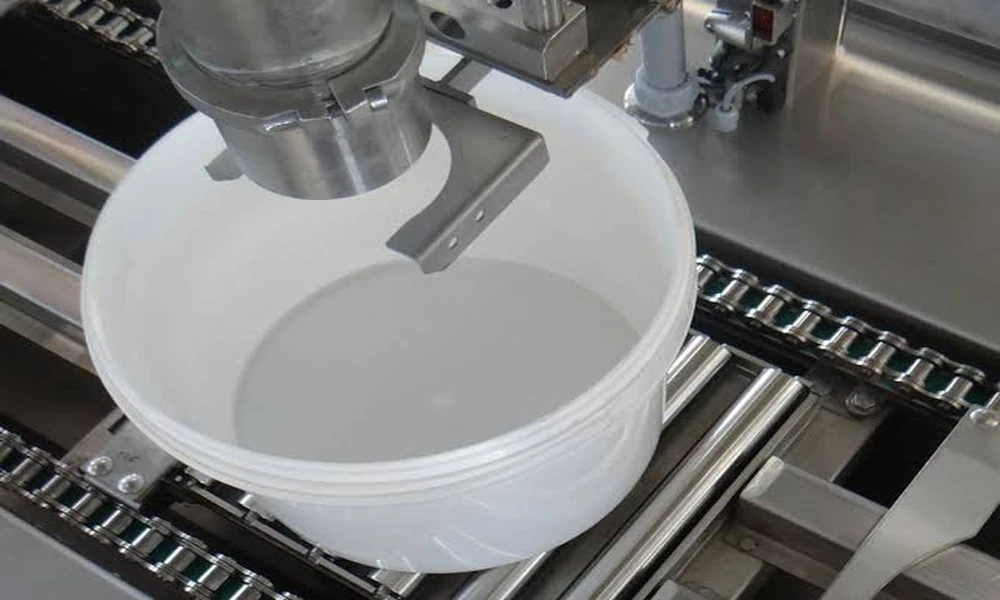
Buying a filling head in isolation is a common early mistake for growing manufacturers, who assume the machine alone will fix throughput problems without considering how it feeds from and into the rest of the line. A complete pail filling system is built around the whole sequence, from empty container to sealed, labelled pail, rather than a single station bolted onto an otherwise manual process.
Why a System View Beats a Single-Machine View
A fast filler feeding into a slow manual capping station gains nothing, since the line’s real speed is set by its slowest step regardless of how quickly product enters each pail. Planning filling, capping, labelling and conveying together avoids the common mistake of over-specifying one station while leaving another as a bottleneck. Facilities that buy equipment station by station over several years often end up with exactly this mismatch without ever intending to.
Core Stations in a Complete Pail Line
A typical system combines denesting to separate stacked empty pails, a metered fill station, capping or sealing, and often a check-weigher before pails move on to labelling or palletising. Each station is sized to the same target rate, so none of them idles while waiting on another. Sizing every station to the same rate from the outset also makes future capacity upgrades simpler, since no single station needs disproportionate rework later.
Cleanliness Advantages of an Integrated Line
Manual handling between disconnected stations multiplies the number of times a pail and its contents are touched, and each touchpoint is a chance for contamination, spillage or debris to enter the product. A connected system minimises open handling, which matters considerably for food, chemical and pharmaceutical manufacturers under hygiene scrutiny. Fewer touchpoints also means fewer opportunities for a container to be damaged or mislabelled before it reaches the end of the line.
Reducing Cross-Contamination Risk
Shared conveyors and filling heads need a defined cleaning protocol between different products, and a properly designed system builds this into the changeover sequence rather than leaving it to individual operator habits. A clean-in-place filling line reduces the manual scrubbing time between runs and standardises what gets cleaned and how thoroughly.
Synchronising Speed Across Every Station
Line controls that link denesting, filling and capping speeds mean an issue at one station, such as a jam or a short pause, is communicated instantly to the others rather than causing a pile-up or a gap further down the line. This coordination is difficult to replicate with separately purchased, independently controlled machines. It also gives operators a single point of visibility into the whole line’s status, rather than having to check each station individually to diagnose a slowdown.
Labour Redeployment Across the Line
Automating the full sequence, rather than just filling, frees staff previously stationed at each manual handoff point to focus on quality checks, exception handling and packing further downstream. Facilities that automate only the fill step often find they have simply moved the labour bottleneck to the next station instead of removing it. Addressing the whole sequence at once avoids this pattern of solving one constraint only to create another immediately after it.
Data Continuity From Fill to Pallet
An integrated system can carry batch and fill-weight data from the filling station through to the final pallet record without re-entering information at each stage, which matters for traceability audits. Disconnected machines generally require someone to reconcile records manually, introducing both delay and the chance of transcription error. That manual reconciliation step is also one of the more common places where audit trails develop gaps that only surface during an inspection. Facilities that have been through a customer audit once tend to prioritise closing this gap well before the next one is scheduled.
Footprint Planning for a Full Line
Because floor space is at a premium in most Singapore facilities, planning the layout for a complete system upfront avoids the awkward retrofits that happen when stations are added piecemeal over several years. A line designed as a whole generally fits into less total space than the same stations purchased and positioned separately. Compact integration also shortens the conveying distance between stations, which in turn reduces the chance of a container tipping or jamming in transit.
Justifying the Investment in a Full System
A complete system costs more upfront than a standalone filler, so the comparison should weigh total line throughput and labour reduction against that higher initial outlay, not the filling station in isolation. Facilities that make this comparison properly usually find the system pays back faster than expected once every touchpoint saved is accounted for. Financing the investment in phases, starting with the stations causing the most disruption today, is often more palatable than committing to the full system at once.
Building the Right System for Your Operation
Map your full sequence from incoming empty pails to outgoing finished pallets before specifying any single machine, and involve staff who currently manage the manual handoffs, since they know exactly where the process breaks down. A well-designed pail filling system should remove those handoffs entirely, not just speed up the single station in the middle of them.

Comments are closed.