
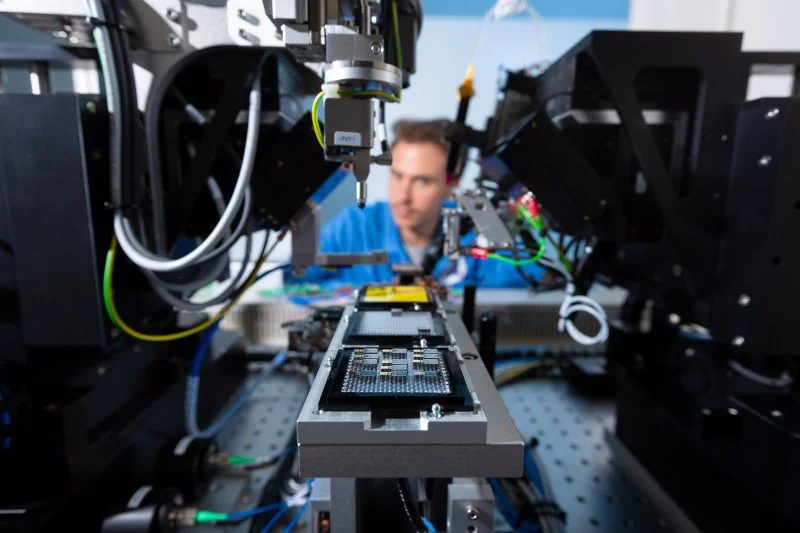
Factories are where imagination becomes physical, where raw materials meet the patience of precision. Inside PsiQuantum’s production lines, that transformation is unlike anything the computing world has seen before. Here, information is not shaped by electrons or metal layers but by light itself. Erik Hosler, a semiconductor process innovation leader specializing in photonic fabrication and scalable integration, underscores that the frontier of computation now begins with mastering photons. His perspective reveals the quiet shift taking place across the clean rooms where the future of quantum technology is being manufactured piece by piece.
The factory hums with a controlled rhythm. Machines etch, align, and measure at scales invisible to the human eye. Engineers move with deliberate precision, adjusting parameters that decide whether a wafer becomes a functional qubit array or a discarded fragment. PsiQuantum’s ambition is bold yet practical: to transform light into logic and achieve this at an industrial scale. The company’s work merges physics with manufacturing, theory with throughput, and discovery with discipline.
Factories that Build Light
Quantum computing has long been imagined as a pursuit of theory and mathematics, yet PsiQuantum has given it a home in the world of production. The company’s fabrication process resembles a semiconductor plant more than a research lab. Photonic chips are fabricated from silicon wafers, which are layered and patterned to guide light through carefully engineered pathways.
These factories draw on decades of experience from the semiconductor industry. The same tools that etched classical processors now carve networks for photons to travel, interact, and entangle. Where traditional chips controlled electrical flow, these new designs control optical coherence. The change feels radical, yet the principles of precision remain the same: eliminate impurities, maintain alignment, and continually refine.
Borrowing the Language of Silicon
PsiQuantum’s most significant advantage lies in its ability to reuse existing industrial infrastructure. The semiconductor world already knows how to produce at scale, manage complexity, and maintain repeatability. Quantum research has rarely enjoyed such stability. By embedding itself within this ecosystem, PsiQuantum transforms fragile laboratory experiments into manufacturable products.
Each wafer is treated like a story written in light. Every defect teaches a lesson, every success adds another chapter. The company’s engineers approach their work with the patience of artisans who know that perfection is never achieved but always pursued. For them, light is both the medium and the message.
The Architecture of a New Machine
Building a quantum computer out of light requires layers of interdependence. Photonic circuits must be etched, mirrored, and interconnected with sub-microscopic precision. The process demands both technological and philosophical discipline. Engineers cannot rely solely on intuition. They must trust measurement, calibration, and repeatability.
PsiQuantum’s production model echoes the logic of semiconductor assembly lines but adds new dimensions of sensitivity. Temperature, vibration, and even air composition can influence outcomes. The factory becomes less of a workspace and more of an ecosystem, where environmental control defines the quality of thought encoded in light.
The Scale of Vision
PsiQuantum’s ambition extends far beyond prototype demonstrations. The company is already engaged in one of the most ambitious scaling efforts in computing history: creating a full-scale, functional quantum computer made entirely of photons. The magnitude of that goal captures both the promise and the pressure of this new era.
Erik Hosler remarks, “PsiQuantum aims to build a million-qubit system, with manufacturing already underway.” His statement transforms the idea of quantum computing from a mere aspiration into an operational reality. The phrase “manufacturing already underway” serves as a signal that the challenge has moved beyond the theoretical stage. PsiQuantum is no longer chasing a concept but assembling a future one wafer at a time.
The work represents not just scientific progress but also industrial courage, a willingness to treat the improbable as an engineering problem rather than a miracle. The factory floor is where that belief takes form. Every machine, every pattern, and every photon contributes to the gradual construction of a system that may alter how the world perceives computation itself.
Learning Through Precision
The process of manufacturing qubits from light teaches more than just physics. It teaches humility. Each step exposes the fragile balance between control and chaos. Engineers adjust, recalibrate, and test guided by both data and intuition. Minor errors can erase entire batches of work, yet those losses provide insight that no simulation can offer.
Over time, the repetition becomes a meditation. The machines hum in familiar rhythm, the monitors glow with spectral graphs, and the pursuit of stability becomes an act of quiet endurance. PsiQuantum’s success depends on turning that rhythm into reliability.
A New Definition of Manufacturing
The company’s approach challenges old distinctions between science and production. In classical industries, invention precedes manufacturing. In quantum technology, both occur together. Each run of wafers informs the subsequent, turning fabrication itself into a feedback system. The process refines theory, while theory refines process.
This merging of disciplines is what makes PsiQuantum’s factory extraordinary. It behaves less like a plant and more like a living experiment. Progress comes not through grand announcements but through countless minor corrections made by people who understand that light, when guided with care, can become a language of computation.
The Shape of Progress
Walking through the corridors of a quantum fabrication facility is like witnessing a collaboration between precision and possibility. Every lens, every beam splitter, every polished surface carries the weight of decades of knowledge. PsiQuantum’s work embodies a belief that the world’s most advanced technologies grow not from disruption but from adaptation.
In this belief lies the quiet heart of the company’s strategy. The same factories that once built silicon logic now learn to create coherence. The same hands that once calibrated lasers for lithography now tune them for quantum interference. Progress unfolds through continuity rather than replacement.
The dream of a million-qubit machine remains immense, yet it is no longer distant. It takes shape in the slow pulse of production lines, in the reflection of light off mirrored wafers, and in the steady patience of those who understand that invention thrives inside repetition.